Archives
-
Reliability: Theory & Applications
Vol. 21 No. 3 (2026)From Control to Catastrophe: A Common Thread in Modern Applied Statistics
This issue of Reliability: Theory & Applications presents a rare collection of studies that, at first glance, belong to incommensurable subject domains — microgrid power engineering, reliability theory, actuarial modeling, and organizational risk assessment at explosive facilities. Yet a careful reading reveals a common methodological axis running through all five papers: the problem of justified model selection under uncertainty and the price of that choice.
The opening paper by Belhouchet et al. sets the tone for the entire collection. Comparing three microgrid control strategies — classical droop control, model predictive control (MPC), and fuzzy logic control (FLC) — the authors move beyond a simple comparison of technical indicators. The application of two-way analysis of variance (ANOVA) and a regression model for predicting energy cost transforms an engineering experiment into a full-fledged statistical study. The key finding — that MPC achieves the best absolute performance while FLC demonstrates practically comparable robustness at substantially lower computational cost — reads as an invitation to discuss where the boundary between optimality and expediency lies. It is precisely this question that becomes the leitmotif of the issue. The papers on distribution theory — the new extended exponential Rayleigh (NEER) distribution by
Kumar et al., the exponentiated Gumbel power function (EGuPF) distribution by Uwadi et al., the induced Xgamma distribution by Ruidas et al., and the resilience distribution based on the Marshall–Olkin framework (RD) by Shameera and Bindu — form a second line of meaning. All four works are devoted to extending classical distributions in order to enhance their flexibility: capturing J-shaped, bathtub-shaped, and non-monotonic hazard functions, modeling right-skewed data, and accounting for the "resilience" effects of a system. What they share is meticulous attention to estimation procedures: maximum likelihood, least squares, maximum product of spacings, and their comparison by mean squared error in simulation studies. Notably, the paper by Ruidas et al. includes a dedicated section proving model identifiability — an issue that often remains behind the scenes in applied literature, yet without which any parameter estimate loses its meaning.The paper by Gvozdev and Ovsyanik transports us to an entirely different plane — organizational risks at explosion- and fire-hazardous enterprises. The "conditional bit" measure proposed by the authors represents an original attempt to quantify the contribution of qualitatively described organizational causes to a realized hazardous event. The use of an additive weighted model and an interval scale, as well as Kendall's coefficient of concordance for assessing expert agreement, demonstrates how a rigorous statistical apparatus can be adapted to weakly structured subject domains. This work is an important reminder that the reliability of technical systems is not reducible to equipment failures; it is to a significant extent determined by the quality of management and the human factor.
The issue closes with a short but conceptually important note by Schabe, in which the Akaike information criterion is applied to compare parametric models with artificial intelligence models. The author's conclusion is disheartening for adherents of "black boxes": as sample size grows, the information loss of AI models increases as O(n log n), whereas a parametric model, if correct, retains a linear dependence. This does not mean that AI is useless — rather, it points to its proper place in the research process: as a tool for preliminary exploration, not for final inference.
The common thread uniting all the papers can be formulated as follows: every model is a compromise between accuracy and complexity, and statistics is the discipline that makes this compromise explicit. Whether it is the choice between MPC and FLC in a microgrid, between MLE and MPS in parameter estimation, or between a parametric and a non-parametric approach — everywhere it is a matter of the same thing: the need for a justified, verifiable, and reproducible choice.
The editorial board hopes that the materials presented here will resonate both with reliability theory specialists and with researchers working at the intersection of statistics, engineering, and risk management. Interdisciplinarity is not a fashionable slogan but a necessary condition for solving the problems that the modern technosphere poses to us.
Editorial Board
-
Reliability: Theory & Applications
Vol. 21 No. 2 (2026)Editorial
Advancing Reliability and Risk Assessment in the Modern Technological Landscape: A Synthesis of Current ResearchThis issue highlights a central challenge in applied statistics and engineering: refining models for uncertainty, reliability, and risk—from cancer survival analysis to automotive safety metrics—demonstrating that methodological rigor is essential for high-stakes decision-making. The first group of papers advances flexible statistical distributions for non-monotonic hazard rates. Kumar and Krishna S. present the Inverse Kies Distribution (IKD), which models bathtub-shaped and reverse S-shaped hazards where Weibull fails; using Bayesian estimation, they confirm its strong performance on cancer data, establishing it as a valuable tool for medical prognosis. Bengalath and Punathumparambath introduce the Harris extended inverted Lindley distribution for upside-down bathtub hazards, while Baishya et al. propose a modified Uma distribution that improves upon existing one-parameter models via a convex combination approach, showing that even simple models can provide superior fits in specific cases.
A pivotal theme weaving through these theoretical advancements is the critical challenge of censored data, a common reality in reliability and clinical trials. The paper by Wijekularathna and Newman tackles this head-on with a novel contribution to Bayesian estimation under progressive first-failure censoring. Their introduction of the censoring-adjusted linear-exponential quadratic (CALQ) loss function is a significant step forward. By explicitly adapting the loss function to the severity of censoring, their methodology demonstrates consistent improvements in both point and interval estimation compared to classical and other Bayesian approaches. This is particularly crucial for practical applications like tensile-strength testing and clinical trials, where data are often incomplete, and accurate inference is paramount.
Beyond traditional reliability, this issue ventures into the frontier of predictive modeling. The work by Oloyede et al. on Quantum Bayesian Time Series Forecasting is a particularly bold and forward-looking contribution. In an era of big data and volatile financial markets, the ability to not just predict but to quantify the inherent uncertainty in forecasts is invaluable. This study's thorough evaluation of a quantum Bayesian model, breaking down uncertainty into its aleatoric and epistemic components, demonstrates its potential to outperform classical models in non-stationary environments. The superior performance of the heavy-tailed error model and the regime-dependent model highlights the critical importance of selecting a model that accurately reflects the underlying data-generating process, a lesson that resonates across all domains of applied statistics.
The issue also addresses foundational challenges in data integrity and system safety. The work by Muradaliyev et al. on ensuring safety and faultlessness in Smart-systems for power installations is a timely reminder that the quality of our analyses is fundamentally limited by the quality of our data. Their proposed method for detecting gross errors by comparing technical and economic indicators against a range of theoretically acceptable values is a practical and crucial step for preventing erroneous decision-making in complex energy systems. This practical concern is mirrored in the theoretical critique by Shevchenko, Netes, and Starovoitov of the ISO 26262 standard's PMHF metric. Their argument that the PMHF should be dimensionless challenges a well-established convention, prompting a re-evaluation of how we define and calculate a metric central to automotive safety integrity.
Finally, the theoretical work by Rumyantsev on the stability criterion for multiresource job queues serves as a bridge between stochastic modeling and the design of modern computing systems. His derivation of a stability criterion for a system where customers simultaneously seize multiple resources is a fundamental result with clear implications for the analysis and dimensioning of cloud computing environments and other shared resource systems.
In conclusion, the papers in this issue collectively illustrate a scientific community that is deeply engaged with the practical challenges of reliability, risk, and uncertainty. They move beyond simple curve-fitting to grapple with the complexities of data incompleteness, the need for uncertainty quantification, the integrity of information systems, and the fundamental definitions of safety metrics. As we continue to integrate advanced technologies into every facet of our lives, the rigorous and innovative research presented here is essential for ensuring that our systems are not only powerful but also dependable, safe, and well-understood.
Editorial Board
-
Reliability: Theory & Applications
Vol. 21 No. 1 (2026)This issue of Reliability: Theory & Applications (RTA), Vol. 21, No. 1 (90), March 2026 encompasses both fundamental mathematical methods — such as adaptive numerical techniques for Markov chains, queueing theory, and Bayesian and nonparametric approaches — and their practical applications across a wide spectrum of industries, ranging from railway transport and energy to pharmaceuticals and consumer behavior analysis.
A key feature of this issue is its emphasis on innovative approaches to data processing under conditions of uncertainty. The authors actively employ fuzzy logic to enhance survival estimates in medical research and to refine quality control methods. The issue also presents studies on the modeling of complex technical systems, including fault tolerance analysis of IoT systems in smart grids, optimization of power supply systems, and wind energy installations. Several articles are dedicated to the development and comparison of adaptive control charts and accelerated reliability testing methods.
Considerable attention is given to the advancement of statistical tools: new distributions (such as the generalized weighted Sujatha distribution and transformations of the exponential distribution) are proposed, along with parameter estimation methods for censored and masked data. The presented research demonstrates the integration of classical reliability theory with modern machine learning techniques, including neural network modeling for the safety management of critical infrastructure and ensemble learning methods for high-dimensional data.
The diversity of topics covered — from the optimization of production systems to the analysis of consumer behavior in the digital environment — underscores the versatility of probabilistic methods and their relevance for addressing contemporary technological and socioeconomic challenges.
-
Reliability: Theory & Applications
Vol. 20 No. 4 (2025)The December 2025 issue of Reliability: Theory & Applications (Volume 20, Issue 4) presents a diverse collection of research at the intersection of reliability engineering, statistical modeling, and applied mathematics. This edition features a wide range of topics, including advanced inventory modeling under memory effects, reliability analysis of phased mission systems such as tethered high-altitude platforms, and innovative applications of machine learning in areas like PCOS diagnosis and predictive quality control in manufacturing. The contributions highlight the growing integration of fractional calculus, fuzzy logic, Bayesian methods, and AI-driven frameworks to address complex real-world problems in industries ranging from healthcare and finance to energy and telecommunications. A significant portion of the issue is dedicated to statistical and probabilistic advancements, with several papers introducing new lifetime distributions - such as the Log Exponentiated Kumaraswamy, Sine Log-Logistic, and Transmuted X-Rama distributions - tailored for reliability and survival analysis. These works emphasize parameter estimation, model flexibility, and applications to real datasets from engineering, medicine, and environmental studies. Additionally, the issue covers queueing theory and inventory optimization under uncertainty, exploring systems with server vacations, customer impatience, retrials, and fuzzy parameters, providing both theoretical insights and practical methodologies for performance evaluation. The journal also addresses contemporary challenges in sustainable and resilient systems, featuring studies on smart grid reliability, microgrid control using reinforcement learning, phase change materials in thermal energy storage, and cybersecurity in IoT networks. Further contributions include reliability-centered maintenance planning, risk assessment in industrial settings, and the use of explainable AI for predictive control charts. With papers from authors across the globe, this issue underscores the interdisciplinary and internationally collaborative nature of modern reliability research, offering valuable tools and perspectives for academics and practitioners aiming to enhance system dependability, safety, and efficiency in an increasingly complex technological landscape.
-
Reliability: Theory & Applications
Vol. 1 No. 4 (2006)Dear friends!
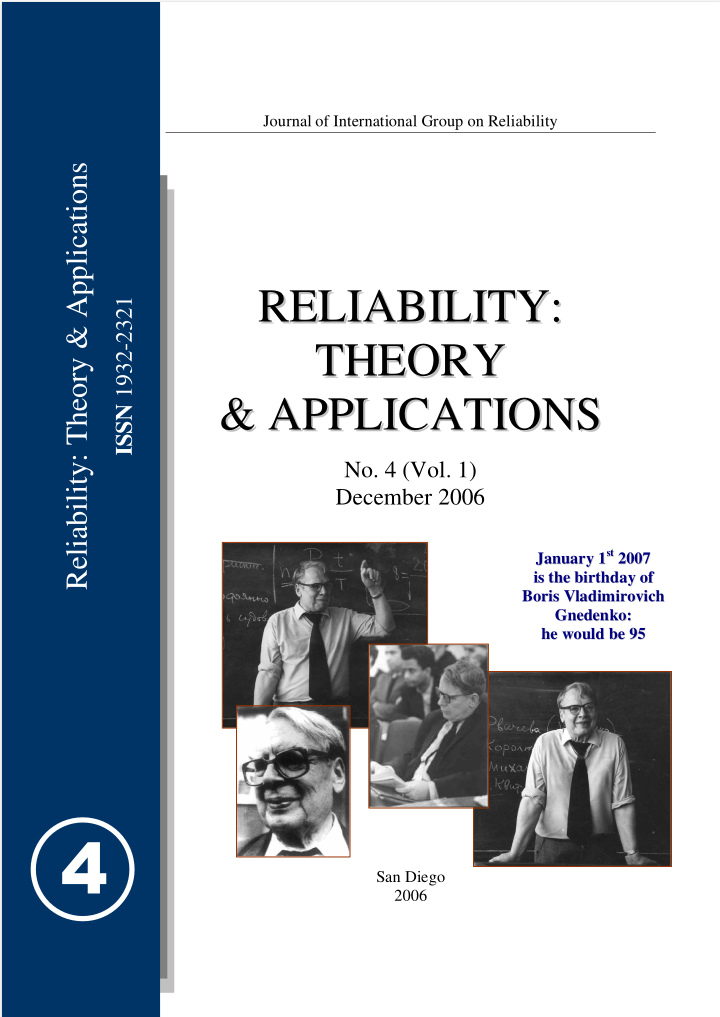
January 1st 2007 is the birthday of Boris Vladimirovich Gnedenko: he would be 95... You look at the No.4 of our journal, where you find many materials dedicated to this date. Our journal exists already a year, it is acting and developing! We have a registration number of the Library of Congress (USA). We are planning to issue the first “paper version” of the journal with collection of some papers. When a year ago it was decided to begin with an e-journal in the frame of the Gnedenko Forum, we did not expect that it would be developing so successfully. The first issues were compiled with invited papers, however, now we have a stable flow of papers even from non-members of the Forum. So, the journal – passing through a difficult time of stabilization – is developing, widening authors’ team and, as we can judge from e-messages, the papers found response among readers. The Gnedenko Forum itself is almost two years old, we have over 70 members of this “informal club” and 5 collective members. The Forum represents Europe, Asia, North America, Africa and Australia with New Zeland! How happy and proud was I when my friends send me thank-you-messages for an opportunity to find old friends through the Gnedenko Forum! Probably, there is a lack of activity and dynamic. We accept all your wishes concerning improvement of the form and content of the Forum that bears the name of the man who for many of us was teacher, friend and colleague. The Gnedenko Forum is the place where friends meet each others, where people contact with their colleagues with whom they work many years ago... And we have to continue our collaboration, we have to bring into our life those ideals that Boris Vladimirovich Gnedenko had been bearing. And who as not him unites us around his name again, as many years ago. Our site is always open for you and your colleagues. Involve new members in our Forum. Send us your papers. Send us information about new books, events, seminars and conferences. Be active and the Gnedenko Forum will return a hundredfold to you.
All the best to all of you!
Igor Ushakov -
Reliability: Theory & Applications
Vol. 1 No. 1 (2006)The inaugural 2006 issue of Reliability: Theory & Applications, designated as Volume 1, Number 1, serves as a foundational bilingual collection that bridges the historical legacy, theoretical developments, and practical methodologies within the field of reliability engineering. This first volume opens with a comprehensive forward-looking essay examining the evolution of reliability science from its past through its present state and into future trajectories. The theoretical contributions include a foundational exploration of generating functions for reliability analysis and optimization, an investigation of generalized birth-death processes as models for system degradation, and a discussion of computer-aided design systems specifically oriented toward reliability objectives. Applied methodology is represented by a study on Monte Carlo approaches for estimating renewal processes within warranty data analysis, presented alongside its Russian translation. A significant portion of this volume is dedicated to honoring the intellectual heritage of the discipline, featuring personal reminiscences about one of the field's foundational figures, recollections and scientific summaries regarding another influential contributor, and a special republication of a conversation with a master of probability theory, all presented in both English and Russian. This unique combination of contemporary research, methodological innovation, and historical tribute establishes the journal's commitment to honoring the past while actively shaping the future of reliability theory and its practical applications.